

The novelty of Nova
Avant-garde movements were particularly effective in mobilizing magazines as instruments of struggle and dissemination of manifestos and principles, even if they did not stand out in terms of durability. In addition to fulfilling the function of combating the past and publicizing contemporary ideals, periodicals also played a strategic role in the process of consecrating and transforming innovation into canon, as they helped disseminate and accustom readers to original aesthetic processes.
From this perspective, some publications became almost synonymous with the Brazilian modernist movement, such as Klaxon, mensário de arte moderna (São Paulo, May 1922 to January 1923), created by Mário de Andrade, Oswald de Andrade, Antonio Carlos Couto de Barros, Tácito de Almeida, Guilherme de Almeida, Sérgio Milliet, Rubens Borba de Moraes, and Luís Aranha; Estética (Rio de Janeiro, Sept. 1924 to Jun. 1925), directed by Sérgio Buarque de Holanda and Prudente de Moraes, neto; A Revista (Belo Horizonte, Jul. 1925 to Jan. 1926), by Carlos Drummond de Andrade, Francisco Martins de Almeida, Emílio Moura, and Gregoriano Canedo; Terra Roxa... e outras terras (São Paulo, Jan. 1926 to Sep. 1926), a fortnightly newspaper-style magazine directed by Couto Ribeiro and Alcântara Machado, with Sérgio Milliet as editorial secretary; Verde, revista mensal de arte e cultura (Cataguazes, Sep. 1927 to Jan. 1928), a project by students Ascânio Lopes, Francisco Inácio Peixoto, Guilhermino César, Henrique de Resende, Martins Mendes, and Rosário Fusco; and Revista de Antropofagia (São Paulo, May 1928 to February 1929), founded by Oswald de Andrade and directed by Antônio Alcântara Machado and Raul Bopp in the first dentição, with Oswald de Andrade, Oswaldo Costa, Jaime Adour da Câmara, and Raul Bopp at the helm of the second (São Paulo, March 1929 to August 1929). These periodicals feature polished facsimile editions, accompanied by dense studies and, at times, testimonies and memorialist texts, in addition to several dissertations and theses focusing on individual titles.
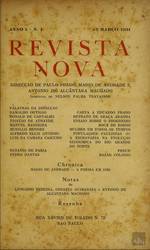
This list does not mean that others did not exist; one needs but mention Novíssima. Revista de arte, ciência, literatura, sociedade, política (São Paulo, Dec. 1923 to Jul. 1926), by Cassiano Ricardo and Francisco Patti; Festa, mensário de pensamento e arte (Rio de Janeiro, 1st series, Oct. 1927 to Sept. 1929), led by Tasso da Silveira and Andrade Murici; Movimento Brasileiro (Rio de Janeiro, Oct. 1929 to Jan. 1930), whose key names were Renato de Almeida and Graça Aranha, a group that, like the previous one, was also the subject of academic studies, although only Festa received a facsimile edition. The former group, however, garnered the greatest critical attention and references in literary history manuals. Revista Nova, launched on March 15, 1931, in São Paulo, by three of the most prominent figures in the cultural scene—Mário de Andrade, Paulo Prado, and Antonio de Alcântara Machado—has not received the same attention from historians. Indeed, there is significant silence surrounding the periodical, which circulated until December 1932, during a period marked by the effects of the 1929 crisis and the initial stages of the provisional government, established by the 1930 coup, led by Getúlio Vargas. Those in power declared their intention to reform the country, anchored in a discourse of separation with previous experience and in favour of modernizing all sectors of national life. Perhaps due to the prevailing climate, the magazine's mentors decided to use the adjective "nova" (new), a favourite of the protagonists of the political world, who considered themselves to be the founders of a new era, that of the New Republic, as opposed to the Old Republic, a pejorative term used to characterize their predecessors.
The manifesto-programme, signed by the owners and directors, begins with the observation of the "immense intellectual backwardness of the country," which is why the magazine "is aimed at a minority, doing everything possible to increase its size." Having presented the diagnosis, the brief text went on to explain the objectives:
“To this end, it will not limit itself to pure fiction. The majority of its space won’t even be reserved for it. Short stories, novels, poetry, and their criticism will occupy no more than the suitable space in a publication whose purpose is to be a kind of repertoire of Brazil. Thus, those interested will find here everything related to even a cursory knowledge of this land, through the unpublished contributions of essayists, historians, folklorists, technicians, critics, and (it goes without saying) literary figures. With impartial dosage. It should be clarified that Revista Nova, while hailing from its land, will also hail from its time. And from latter, it will, above all, share the polemical aspect that characterizes it.”1
The ambition of Revista Nova, conceived and directed by prominent figures of modernism, subordinated fictional production and the discussion of aesthetic issues to the goal of establishing itself as a space for reflection and debate about the country's future and national reality. This proposal resonated with the current situation, marked by the urgency of self-knowledge, a stance that forcefully resurfaced and ushered in yet another rediscovery of Brazil. In his correspondence, Mário insisted on this point and reaffirmed, on several occasions, the principles enunciated in the introduction that guided the selection of material for publication. Months before the first issue appeared, he informed Augusto Meyer: "It is a serious magazine, at least 150 pages long, quarterly, with very little literature, at least free literature. Much criticism and many studies of any kind that have an immediate correlation with Brazil."2 Furthermore, he assured his friend that "the magazine—you know us, or at least I do—will not have the slightest “estaduanista” restrictions; it will be of interest to and dissemination of Brazil." Shortly after, to Câmara Cascudo, one of the regular contributors, he stated: “We want the article on Álvares de Azevedo and smoking right away (...). As for Buda, for now, it’s not really relevant to the Brazilian orientation of the magazine, it would lead this orientation astray, which is actually the only one that’s really fixed for the body of artists: things that are directly of interest to Brazil.”3
The magazine was, in fact, new in the sense that it broke with the recent tradition of modernist periodicals along the lines of Klaxon, since its purpose was not to combat the prevailing literary order, nor to proclaim and exercise the right to experiment, but rather to contribute to the commitment to understand the country—a project that neither excluded nor promoted literary creation. Manuel Bandeira was apt to emphasize, in a letter to Mário de Andrade dated April 14, 1931, that "I can immediately say that I fully agree with the magazine's representative programme (...). What is needed is a magazine that serves as a kind of archive of our general culture. The advantage of being written by vanguard people is that it also includes the vanguard, and a well-chosen vanguard"4.
On the other hand, the proposal loses its innovative tone if viewed from a diachronic perspective, as it is possible to recover the threads of a tradition that went back, at least, to Revista do Brasil (São Paulo, Jan. 1916 – May 1925), since Nova brought back proposals typical of cultural magazines, with particular emphasis on the one that was the most important of its type and which had Paulo Prado as director from January 1923 until its closure, a period in which Mário de Andrade became a contributor5.
The similarities between the two publications are striking, not only in their objectives but also in their dimensions, cover design, and internal content layout. As with its predecessor, each issue of Revista Nova generally opened with an editorial (Momento), whose title was virtually identical to that adopted by Revista do Brasil (O Momento) during Paulo Prado's time, and which, more often than not, addressed pressing issues. Articles followed, always preceded by the reproduction of a document of historical value and interspersed with fictional works. This set concluded with the sections Crônicas, Notas, Resenha, Brasiliana, Etnografias, which were not published in all ten issues. Among those who wrote the much-desired studies were, in addition to the directors, Luís da Câmara Cascudo, Ronald de Carvalho, Tristão de Ataíde, Octávio de Faria, Alfredo Ellis Júnior, José da Silva Gordo, Martins de Almeida, Antonio Piccarolo, Astrogildo Pereira, Afrânio Peixoto, Homero Pires, Azevedo Amaral, Artur Motta Filho, Osório César, a sample that indicates the diversity of political positions that the magazine was able to bring together over the course of its eight issues, fulfilling, at least in part, the initial program.
It should be noted that the title takes on a particularly ambiguous tone, and could even be questioned if one were to make a comparison with the avant-garde periodicals of the 1920s, whose group is considered to have concluded with the Revista de Antropofagia, which, incidentally, marked the break between Mário and Oswald de Andrade. Nova embraced other challenges, and in this sense, there would be nothing new in the final publication launched by the protagonists of the Semana de Arte Moderna, from then on held apart not only by disputes surrounding the movement's legacy, evident since the mid-1920s, but also by doctrines and political struggles that marked the 1930s and led them through different paths.
It's understandable, therefore, that Nova wasn't included in the sequence of titles consecrated by the discourse on modernism. The magazine had a short life and circulated during a time of great political uncertainty, made particularly tense by the 1932 movement, which pitted São Paulo against the rest of the federation and ultimately sealed its disappearance. Perhaps because it proposed to reconcile participation in debates surrounding the country's future—a stance typical of predecessors like Revista do Brasil—with the achievements of the avant-garde, Nova still occupies a gray zone and remains forgotten, in a sort of in-between space awaiting researchers to clarify the role it played in its time.
Tania Regina de Luca
-
Untitled opening text, signed by the three directors. Revista Nova, n. 1, pp. 3-4, Mar. 1931.↩︎
-
Lygia Fernandes (org.), Mário de Andrade escreve cartas a Alceu, Meyer e outros, Rio de Janeiro, Editora do Autor, 1968, pp. 83 and 84, letter from 23 Jan. 1931, which indicates the preparation process for the magazine’s launch was careful.↩︎
-
Veríssimo de Melo (org.), Cartas de Mário de Andrade a Luís da Câmara Cascudo, 2nd ed., Belo Horizonte, Itatiaia, 2000, p. 104. The expression "body of artists" may be due to a mistake in the transcription of the document or of the author himself; more likely, it referred to the body of articles. In a new letter to Cascudo, dated May 29, 1931, Mário returned to the topic: "we find the subject [Buda, Catholic Saint], for now, unsuitable for us, given that we have not yet definitively settled on it, and want to fully characterize the magazine as an intrinsically national organ of interest and research.", p. 108.↩︎
-
Marcos Antonio de Moraes (org.), Correspondência Mário de Andrade & Manuel Bandeira, 2nd ed. São Paulo, Edusp, IEB, 2001, p. 499.↩︎
-
Revista do Brasil was launched in January 1916 by Júlio Mesquita, owner of the newspaper O Estado de S. Paulo, and acquired by Monteiro Lobato in May 1918. To import modern machinery for his printing and publishing house, Lobato partnered with businessman Paulo Prado. The magazine's initial series ended due to the bankruptcy of Lobato's business.↩︎